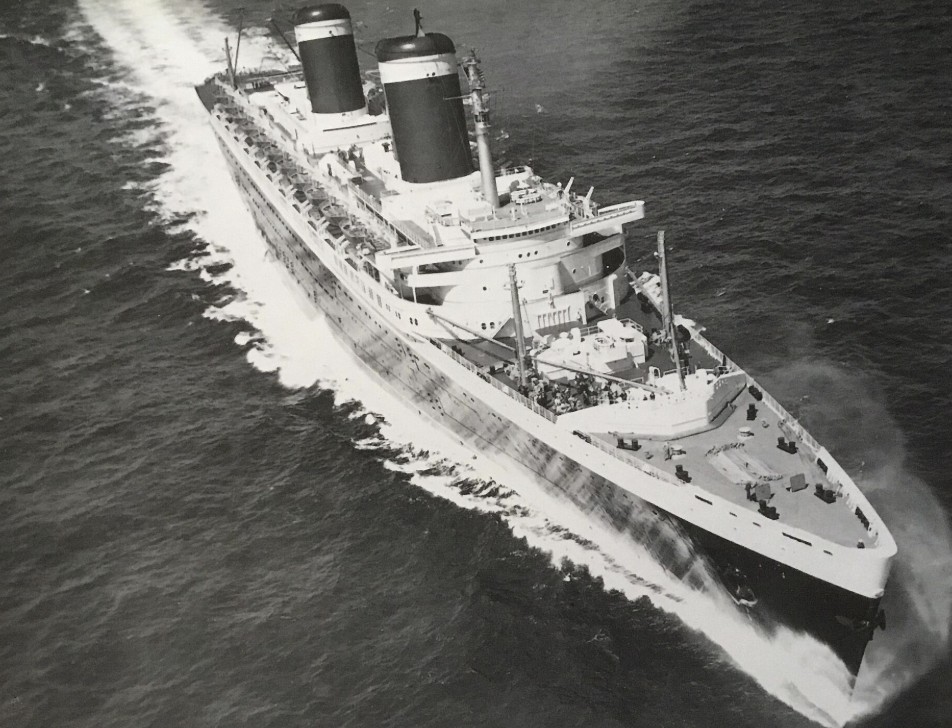
When I was younger my dad and I built a three-inch-long model of the SS United States luxury liner that even lit up. I loved the ship as a kid and it did not hurt that in addition to its beautiful, sleek aesthetic, it also set the transatlantic speed record in 1952, the year it was commissioned and still stands today. The model sat on my parent’s living room bookshelf long after I had moved away. Below is the SS United States soon after its construction in 1952.


Some great color photos of when it was new in 1952 can also be found here and here.
The SS United States had a smaller precursor sister ship named the SS America, designed and built around 1940, 12 years prior. The sister ships in New York harbor together can be seen here.
The SS United States (below) after being decommissioned has been rusting away for the last 30 years at the Delaware River docks in Philadelphia.


This is a great video of a tour of the decaying ship in Philadelphia
Okaloosa County, a county along the southern coast of the Florida Panhandle has purchased the decaying SS United States. The purchase price was somewhere around ten million dollars I have read. Their intention is to sink it in the Gulf of Mexico about 20 miles from shore as a tourist destination reef for fishes and divers. Currently the ship is docked in nearby Mobile, Alabama, for the stripping of all parts and fuel containers that could pollute the waters of the Gulf. Take a look at the trip from Philly as it was being towed to Mobile and at the ship before being stripped.
This image shows the beginning of the stack removal in Mobile at the docks. See what is currently left of the hull here.
Unfortunately the SS America came to a terrible and even worse end than its sister ship when being towed from its then owners in Greece to its new owners in Thailand. The intention was to make it into a tourist hotel, but it was not meant to be. A storm in the Atlantic Ocean en route blew it from the tug towing it and the whole thing crashed to the shore in the Canary Islands, where it eventually broke in two and simply rotted away. By this time the interiors had been gutted and removed, one of the two stacks removed, and the interiors subsequently sold off to the highest bidder.

More photos of the shipwreck. Both ships have been destroyed or dismantled but there remains an interesting backstory of their design. The architect of both ships is William Francis Gibbs.

This is a another photo of William Gibbs posing with a model of the SS United States in 1946.
The mid-century modern interiors however were designed by Anne Urquart and Dorothy Marckwald of the firm Smyth Urquart Marckwald. See this SS United States Conservancy photo where they are posing in front of the SS America, their first interiors foray into luxury ship interior design and adescription of their role as being on the cutting edge for their time.
It was truly a big deal in the late 1930’s and ‘40’s to depart from a more traditional Victorian interior as seen in ships up and until that time. The SS America's interior was also designed by Marckwald in the late 1930’s, and it hinted at this modernism as well. The other term used by the interior designers at that time was “Hollywood Modern”. They wanted the ship’s interiors to be more “American”.
William Gibbs was born in Philadelphia in 1886. Always having a passion for ships, he studied engineering at Harvard, but left to obtain a law degree from Columbia in 1913. Ultimately he left the practice of real estate law in 1916 and somehow with the financial backing of J.P. Morgan Jr. he convinced the U.S. Navy that he could refit the confiscated German ship the Vaterland and turn it into a state of the art combination luxury liner and troop transport. The ship was renamed to Leviathan and it made several troop transport runs to France during WWI, even though tragically the world wide pandemic of 1918 ran rampant amongst the troops on most of its voyages. Death was common. Suffering of flu symptoms affected both nurses, doctors, and of course the troops themselves on each trip. A young Franklin Roosevelt was one such sufferer.
The Leviathan (below) was a forerunner of Gibbs later ventures with the SS America and SS United States.


(Side note here with regards to the SS Leviathan: the interiors of were comprised mostly of fine woodwork, something later William Gibbs prohibited in the interiors of the SS United States since it was of a combustible material.)
After Gibbs became successful in the design and construction of ships, he formed a new company in the 1930’s, Gibbs and Cox, whereupon he had his first opportunity to design what he considered to be the fastest ocean liner ever built, the SS America, which, as mentioned above, was the precursor to the later 1950’s SS United States.
The 1930’s simple, modern, and striking interior design of the SS America was designed by a young Dorothy Marckwald. She described the interiors as being simple and comfortable in an “American Way”, or in her other words as “Hollywood Modern” as mentioned above. See here for one of the SS America lobbies.
After WWII, Gibbs was even more obsessed with designing a ship with speed. Hence, the opportunity arose with the commission to design the SS United States, its interiors again to be done by the team of Urquart and Marckwald.
Elaine Kaplan is the main engineer responsible for designing the propulsion system that set the speed record. The record is from New York to England in 4 days and 10 hours. It moved at 38 knots, which is about 44 miles per hour. This photo shows a luncheon with Elaine Kaplan and the architect Gibbs with other engineers.
It turns out that it came up in a conversation I had with our tax preparer recently that she in fact had traveled to England on the SS United States when she attended school there in 1963. The SS United States last voyage was in 1966 when it became no longer financially feasible to operate in competition with air travel, but in 1963 it was still a pretty common way to travel to Europe.
Some photos of the interior can be found here.
The following link is to a series of photos showing the ballroom and the main stairs the SS United States as it was and as it is now after it has been stripped.
I do know though that my family still has the model my dad and I built. Somewhere.
Blog post written by David Tritt, Senior Architect.