The U.S. Open Golf Championship concluded in June on Long Island at the Shinnecock Hills Golf Club and I thought I would talk a bit about its clubhouse. I first noticed it when watching the U.S. Open in 1986. I saw this beautiful low-slung, clubhouse-type structure atop a hill in the background of some of the shots when watching television. Although I did not know at the time, it was the Stanford White–designed 1894 golf clubhouse built during the infamous Gilded Age. It is the first and oldest golf clubhouse in America. Although it has been remodeled over the years, its original formal expression is still intact:
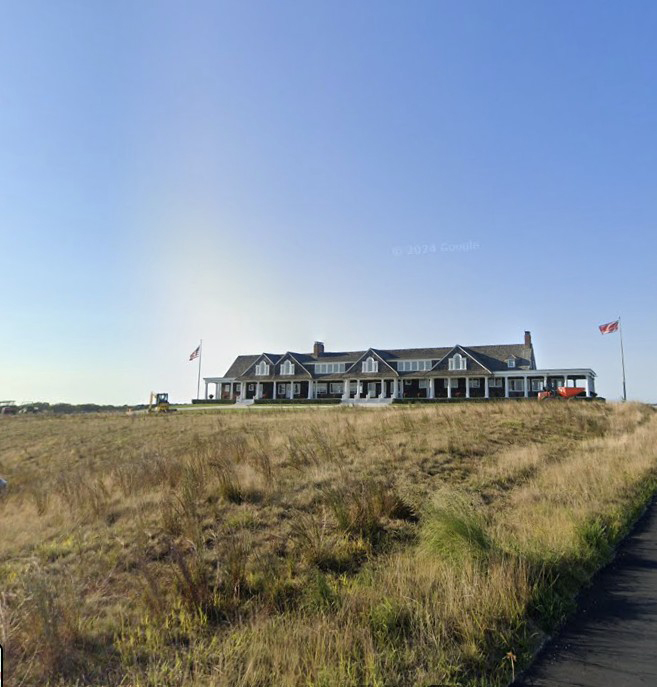
A modest work, it is striking in that it was the first one of its kind. It is one of those pieces of architecture that marries perfectly to the majestic piece of property upon which it sits. It’s dramatic.
Below are a couple of historical photos taken around 1900:

.jpg)
I meant for this blog to be about my thoughts concerning the Shinnecock Hills Golf Clubhouse being an architectural first, but instead I found out about John Shippen. He was Shinnecock’s assistant golf pro and the first American-born golf professional. Mr. Shippen was the son of a slave.

Here is a better photo of John Shippen along with a bio. John Shippen broke the color barrier at the Shinnecock Hills Golf Club when he attempted to enter the 1896 U.S. Open held at the newly formed all-white golf club. But the USGA president at the time, Theodore Havemeyer, declared that there would be no tournament if Shippen were not permitted to enter. He played well and placed 5th. Shippen was not only African American but also partially Native American, just like Tiger Woods. The similarities to the greatest of all time are something to contemplate. Bookends within the history of the game. Mr. Shippen lived until the 1960’s but never until after his death did he receive proper recognition for his pioneering efforts and contributions to the game. Thankfully, though, proper recognition was given by NBC Sports at this year’s U.S. Open. Not enough in my opinion, but it was done in a most respectful manner.
Back to Stanford White:

Stanford White was the designer to the stars during Manhattan’s Gilded Age and a partner in the famous firm McKim, Mead, and White. The partners are shown below:

Unfortunately, Stanford White was murdered by the husband of a former lover. White was a man about town but at the same time a rather sleazy character. Harry Thaw, White’s killer, was married to Evelyn Nesbit:

Evelyn Nesbit was a New York model and an actress whom Stanford White seduced against her will when she was just 16, and with whom he continued an on-again-off-again affair the following 3 years. Apparently, he had numerous affairs which led to his ultimate demise.
The trial of his killer, Harry Thaw, was considered and always thought of as the “Trial of the Century,” at least until the O. J. Simpson Trial in the 1990’s. Stanford White, it turns out, made a habit of having relations with other underage girls, for which he became infamous. No one did anything to prevent it until Harry Thaw shot him three times for having forced himself upon Nesbit. This occurred at a performance of a play in 1906 at one of White’s projects, the Madison Square Garden rooftop theater (below):

Harry had a legitimate history of mental illness and was thus acquitted by reason of insanity after two trials. Thaw wrote the following book in an attempt to vindicate the murder:

Thaw lived until 1947 and died a peaceful death in Florida, having been satisfied to his dying day that he did the right thing. Apparently so did everyone else, including law enforcement, as seen in Thaw’s jail cell below that included catered meals from Delmonico’s and a brand-new brass bed:

Much has been written about White’s murder and about Evelyn Nesbit; even a movie about it was made in 1955 entitled “The Girl in the Red Velvet Swing” (yes, Stanford White had a red velvet swing in his living room in his townhouse on 24thStreet) with Joan Collins as Nesbit and Ray Milland as Stanford White. The movie, however, portrays their relationship as a romance which it clearly was not, as Nesbit testified at the trial. She was 16 and he was 48, and he was accused of drugging her. In addition, there is currently an HBO series entitled The Gilded Age which also portrays White’s proclivities, but I do not know of its accuracy for I have not seen the series.
Now…given all of this, Stanford White’s firm, McKim, Mead and White, did a considerable amount of work, some of which is/was quite good. All 3 were young when they formed their firm in the 1890’s, but were well connected. Stanford White himself was not formally trained as an architect; instead, he obtained an apprenticeship with the famous architect H.H. Richardson. Having said this and having not a bit of admiration for White’s character, his professional background should get a mention.
From high school, he went to work as an apprentice for six years for H. H. Richardson, as mentioned above. Richardson was a character in and of himself (although his mother sold slaves from their Louisiana family plantation to pay his tuition at Harvard…not something to brag about to say the least and something to be taken very seriously when discussing Richardson). I mention Richardson though in the context of White’s architecture, that of McKim, Mead, & White’s light wooden-esque New England Shingle Style, and it being quite a departure from the heavy-handed stone buildings of H. H. Richardson, for which White was trained. This shingle style, with its sometimes elaborate detailing, is also a departure from the modern American architecture being developed in the Chicago School at that time. But the simplicity of the Shinnecock Hills Clubhouse was before the more ornate buildings that came later. And much better, I think, at least in the case of the Shinnecock clubhouse.
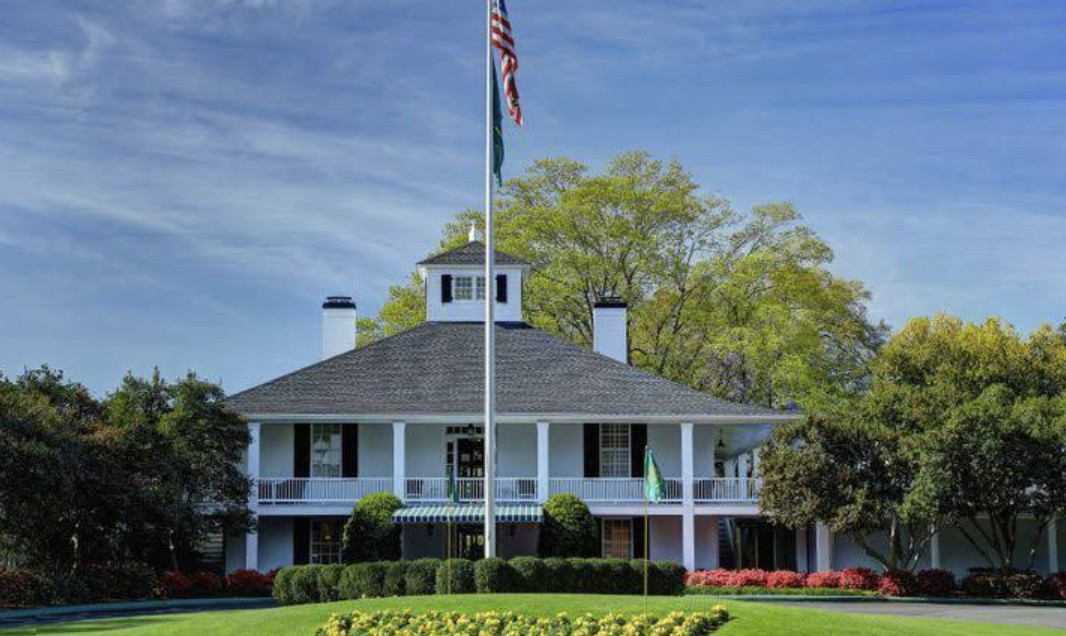
PS: A note also about the 1934 (originally 1854) Augusta National Golf Clubhouse shown below and its antebellum roots:
A postcard view of Augusta Golf Club in the 1940’s:
.jpg)
Its simplicity, like Shinnecock Hills, is stunning. However, it was originally an 1854 home on a slave plantation built by Dennis Redmond, not a clubhouse. It was only later, in the 1930’s, that it was converted to a clubhouse when Augusta National Golf Course, home of the Masters, was built. Its architectural heritage, unlike Shinnecock, comes from a different place and can be seen in the Creole architecture of the 1790 Southern Louisiana Destrehan Plantation House, photo below:

The Destrehan Plantation House, also built by slaves for Robert de Logny from 1787 to 1790, is interesting for its similarities to Shinnecock in its simplicity; Shinnecock, however, does not share in its history of slavery beginnings. The Augusta clubhouse does, however. It is an icon of the Masters tournament but is not currently well known for the enslaved peoples who built it. I hope there are sports fans who know this history when watching the Masters.
Blog post written by Senior Architect, David Tritt.