In his YouTube video When Architects Copy, Stewart Hicks, professor of architecture at the University of Illinois, Chicago Campus, asks the question if it is ok to copy, especially when it is honestly fake like in Las Vegas. He describes several examples from around the world. Or are they simply a derivative? It's an interesting topic and an ongoing issue throughout the arts.
Quentin Tarantino in his own work for instance. Stewart Hicks points out in his documentary how Tarantino references constantly to movies of the past in his own work, making it a cornerstone of his trademark. He is direct and honest about it, which has served him well.
Not so well for David Childs it seems, in that there was a lawsuit settled out of court from his former student Thomas Shine with regards to Childs' Freedom Tower design while at firm Skidmore, Owings & Merrill (SOM). Shine was a student of Childs at Yale (Hicks' documentary however said it was at IIT) that alleges Childs ripped off his student work in Childs' design for the new Freedom Tower below. Judge for yourself: Illustrations for Shine v. Childs.

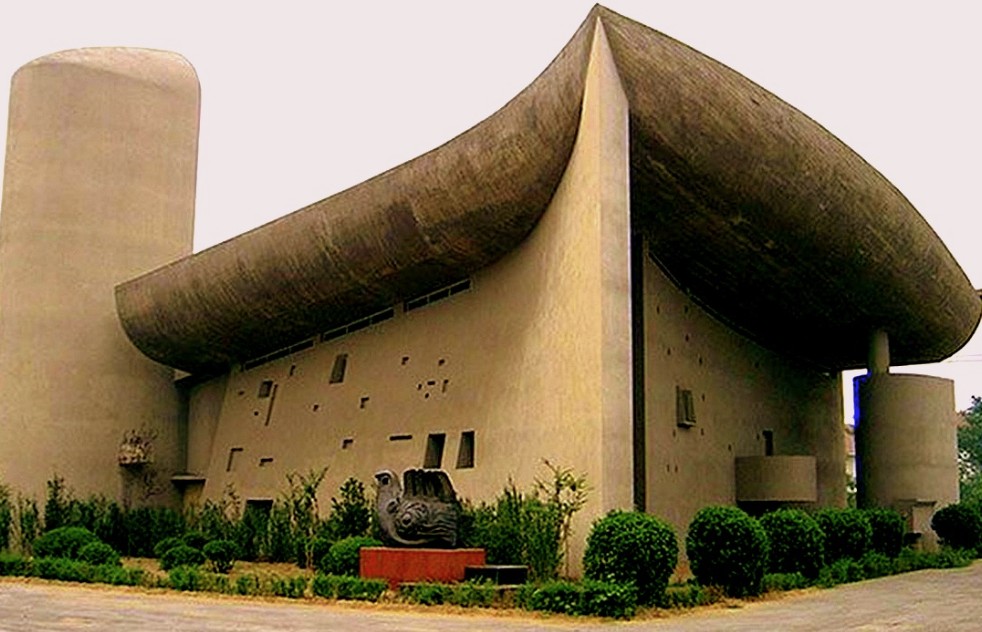
Professor Hicks goes on to show other examples as well of more easily provable direct copies, such as the copy in Zhengzhou, China, of Corbu’s 1955 Chapel at Ronchamp (original below top, copy below bottom). The copy is now a BBQ restaurant. It would be interesting to view the interior for Corbu’s real chapel is one of the most beautiful and impressive interiors the world has seen. Who knows what an adaptation of a BBQ eatery would be in such a space.


Just as literal, although done with a bit more intellectual punch, are two projects by the Australian firm ARM, who copied in a distorted kind of way the house Robert Venturi designed for his mother Vanna in Philadelphia (below).

The distorted version was used as a model for the design of the Howard Kronberg Medical Center. What the architects did in the design of the medical center was to slide a black and white copy of the front façade of the Venturi Residence across a Xerox machine, then adapted the resultant image to be built, imperfections and all. As a consequence, the front façade of the new medical center is a direct copy of that distorted image.
ARM did not stop there. Their next foray into this type of image making was to copy Villa Savoye as a darkened attachment to the rear lake side of the new Aborignal history museum (the AISTSIS) outside of Canberra:
"Le Corbusier- Villa Savoye, 1928-30" by roryrory is licensed under CC BY-SA 2.0 

 .
.
The below derivative is explained from ARM as an “inversion concept” behind the architecture, related to the perceived attitudes toward Aboriginal culture. Check out the short film Double Negative by the architect Howard Raggatt (the R in ARM) for more.


Also mentioned in Stewart Hick’s video is a derivative version of Villa Savoye done by Rem Koolhaas near Paris. Villa Savoye is of course one of the great pieces of architecture, and the reinterpreting of its visual essence in Koolhaas’s Villa Dall’Ava can be seen here.
.jpg)
Take a look at lookalike in Greenwich, Connecticut (there are many): Frank LloydWright Fallingwater lookalike asks $3.5M in Greenwich, CT | 6sqft.
Over the years I have occasionally run into scaled down versions of the famous Kallmann McKinnell & Wood’s Boston City Hall design, which was of course the much maligned and sometimes praised winner of the famous 1960’s Boston City Hall design competition shown here:

The architects have always said that their entry was inspired by Corbu, and inparticular the Monastery Sainte Marie de la Tourette (below). After being itself a derivative of the monastery, Boston City Hall is In turn furthercopied by many other examples over the years, some examples to follow.
"Couvent Sainte-Marie de La Tourette (Le Corbusier) - Éveux" by westher is licensed under CC BY 2.0 .
A first example, done as a suburban office building, was (and is) located here in the Bay Area at 1710 Gilbreth Road in Burlingame, right off of US 101 south of SFO. It was however redone around ten years ago and now in its present form it no longer exists as a mini copy of Boston City Hall. What remains is not what it was.
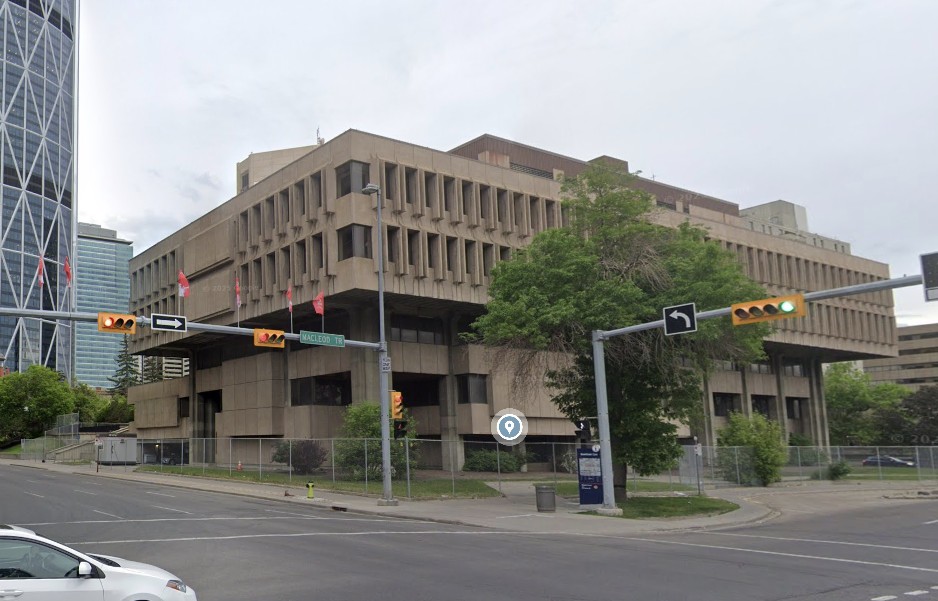
Below are other examples, such as 550 South California Street in Palo Alto shown below. A more direct derivation is the abandoned Board of Education building in Calgary, Canada (below).

There also exists a story behind the Boston City Hall plaza upon which the building sits. It is a direct copy/derivation of Sienna’s Piazza del Campo and was adapted by I.M. Pei’s office in 1962 for the city of Boston (below).


The 1970 Ohio Historical Society Museum in Columbus, Ohio is a building that I have often admired and is, alarmingly so, practically the same building as the Cultural Center of the Phiilippines facility in Manilla. Both sit on a podium (the traditional piano nobile level) within a floating concrete geometry, and especially, as seen from the adjacent freeway at 65 mph, the Historical Society Museum really stands out. The Cultural Center of the Philippines was built around the same time )(1966-1969) and I do not know which was first, but the similarities are striking.
Ramps in both projects extend to the podium level and become a major feature of the architecture, with the only difference being the ramps return on themselves at the Cultural Center rather than extend outwards in a curvilinear fashion at the OHSM. It is interesting to me how these two pieces of rather fine architecture ended up being designed and built around the same time and being so similar. I did know that the Columbus architect W. Byron Ireland designed the Ohio Historical Society and had at one time worked for Eero Saarinen, but it was later that I learned that the Cultural Center architect, Leandro Locsin, had on his only trip to the U.S. worked and/associated with Saarinen and likely knew Byron Ireland. The rest we can only speculate.
The similarities however can be seen below:
.jpg)

Looking back there was a precursor to the above 2 projects: It was the 1960 Kahnand Jacobs American Airlines terminal 8 at JFK with its beautiful Robert Sowers stained glass façade facing the entry procession. There is, like in the above 2 projects, an elevated piano nobile level upon which the rather elegant elongated version of the upper architecture is placed.
American Airlines Terminal 8 at JFK (now demolished), can best be seen here. It’s easy to agree that this ‘60’s airline terminal is pretty elegant in the way it establishes the precedent for the derived notion developed later, in both the Ohio Historical Society museum and the Cultural Arts Center of the Philippines discussed above.
Similarities of The 1960 American Airlines Terminal at JFK and The 1970 Ohio Historical Society Museum in Columbus can be further seen in these aerial photos. The airline terminal is truly a beautiful building and is a shame it got demolished.
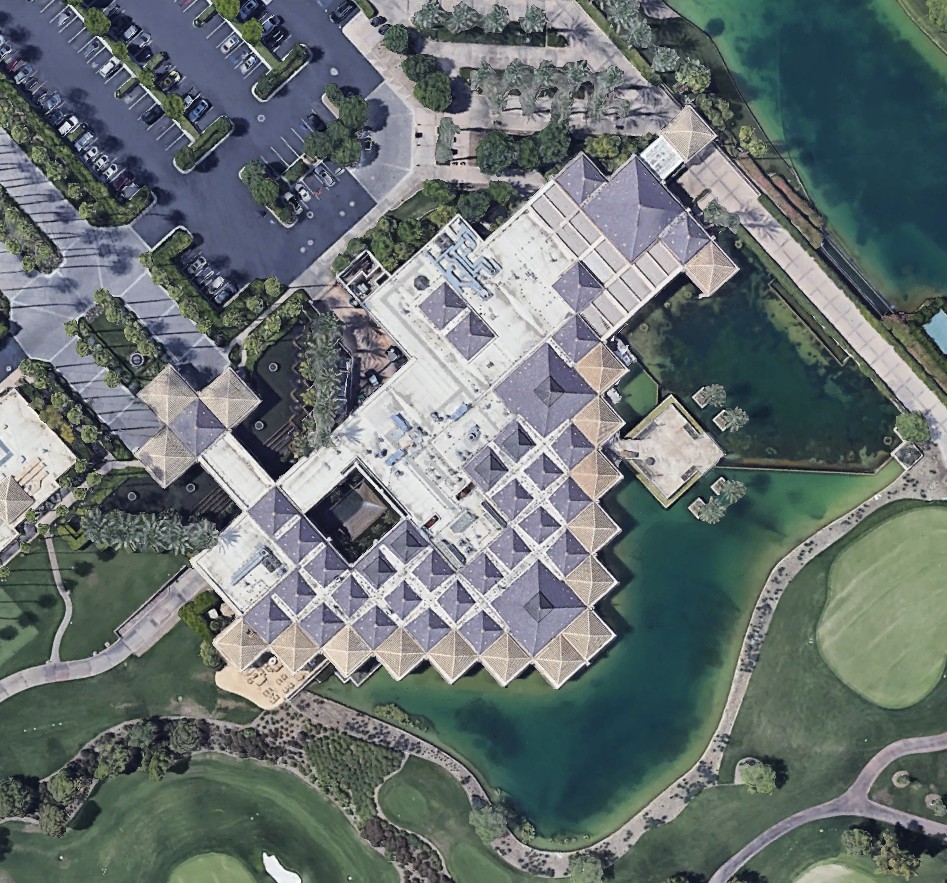
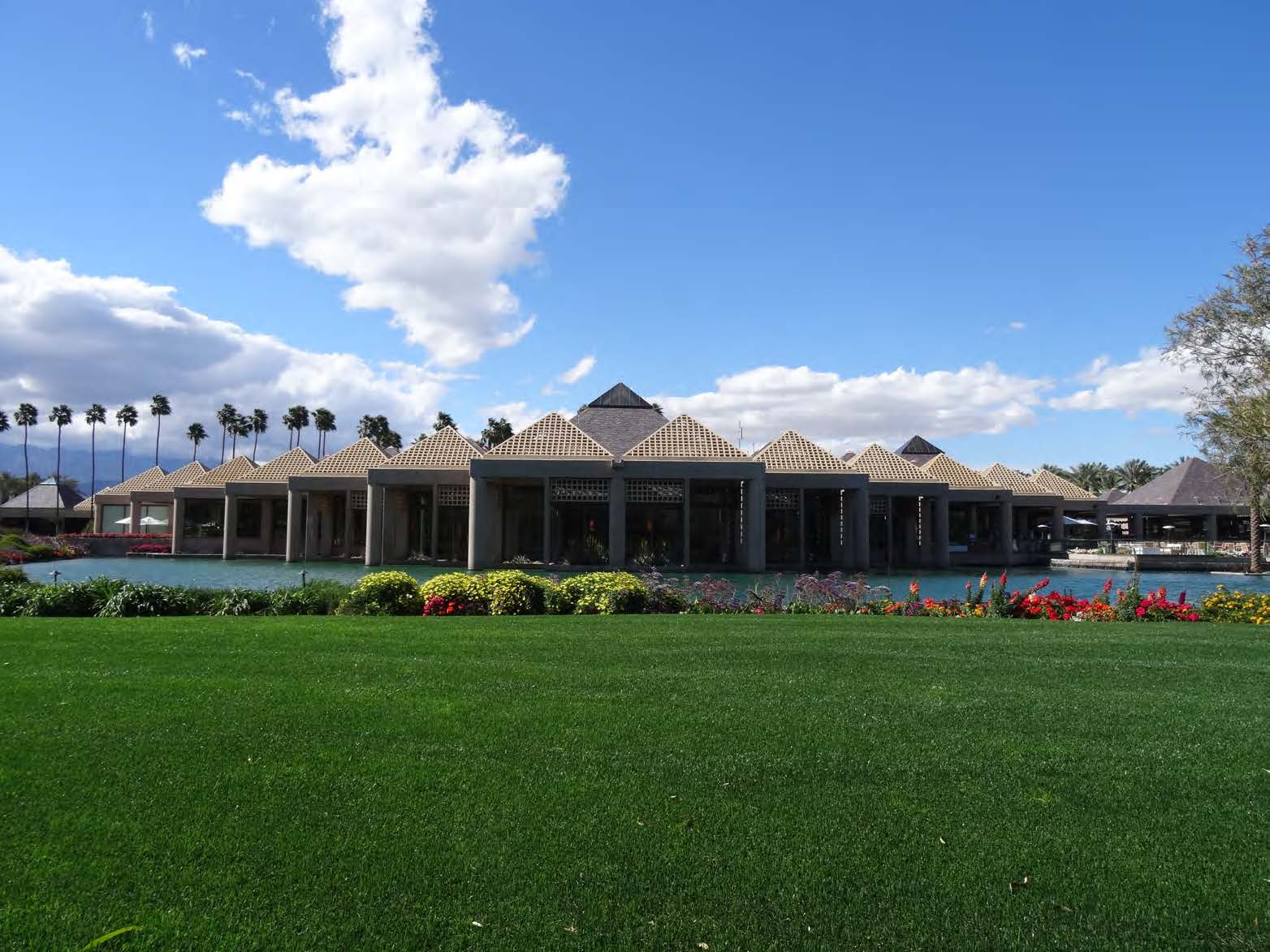
The Vintage Club in Indian Wells, California, is a golf clubhouse that was designed by Bo bGeering, the design principal at Fisher Friedman Associates here in San Francisco, back in the 1970’s. Interesntingly when in a helicopter searching for a different project site near Chiba Japan, Bob saw his building transplanted into the landscape below. It turns out that in fact the Kimisarazu Golf Club replicated Bob’s design of the Vintage Club.

The borrowing of certain details is common in architecture and is seen often inhistory. Examples of borrowed detailing is a derivative and can be seen here in St. Peters Seminary in Scotland. “Borrowed” arch details from Louis Kahn’s Ahmedabad Indian Institute of Management below:


Occasionally something comes along that, at least to my eyes, is refreshingly original and is based on derivations of a geometric. This section is going to be about round buildings and fits into the derivation narrative.
One such building I found is in Ljubljana, Slovenia:
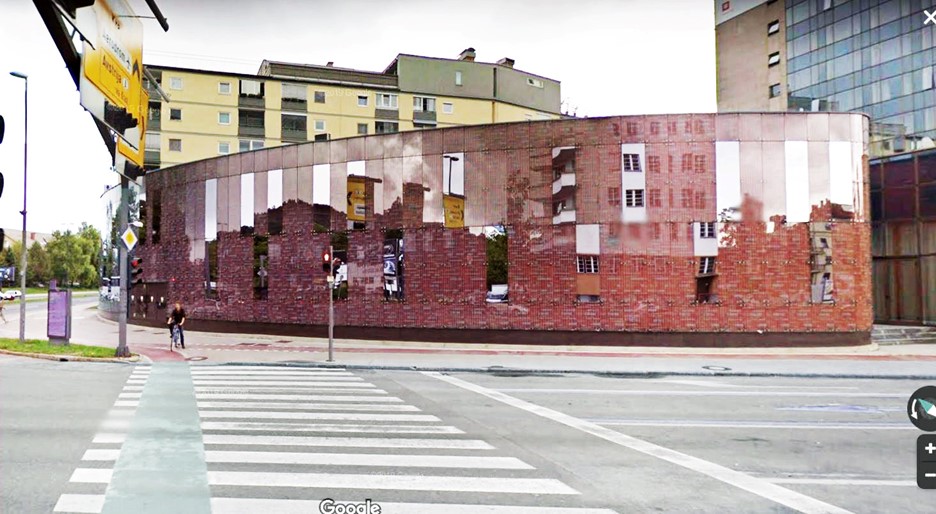
I don't know what this architecture is used for or who designed it, but it is adjacent to the Hotel Lev on the right and is beautiful. If anyone knows let me know, it’s a great way to turn the corner.
I know there is no patent on round buildings, examples abound, but I want to share a couple of round elementary schools, one of which is in India, The Rajkumari Ratnavati Girl's School by Diana Kellogg Architects.
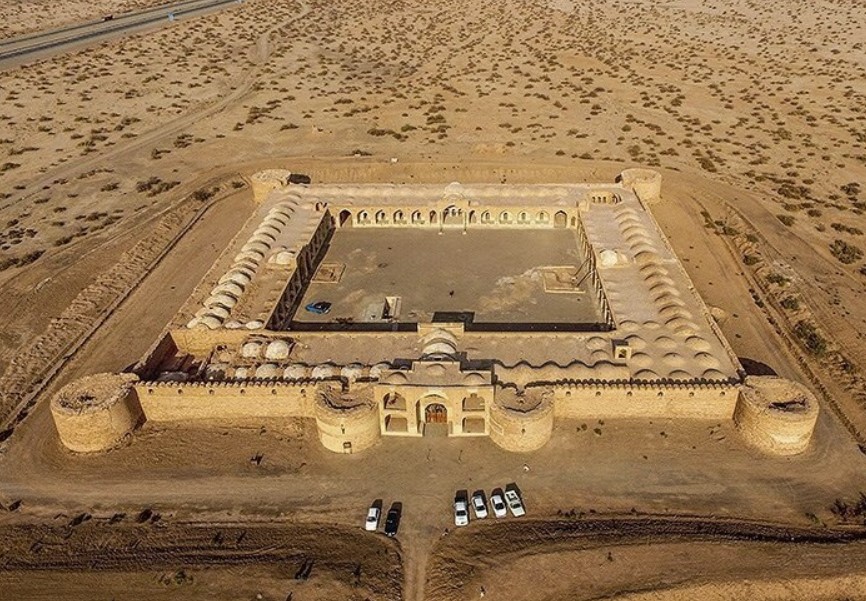
Another example of a second round school is the Jadgal Elementary School in Iran.
Below is the Tobias Elementary School in Daly City, CA:

.jpg)
These round buildings are a bit of a transition to the more famous derivative Apple Headquarters in Cupertino, CA, a very famous building by Norman Foster. It is striking in the similarities though between Foster’s Apple building design and an earlier Gensler design for the British Government Communication Headquarters (GCHQ) in Cheltenham, UK, shown in the lower photograph.


Both are great buildings of course, but Foster’s derivative and immensely popular design for Apple is iconic. A round building mention also is of Crispin Wride’s 2001 Diamond Particle Accelerator in Oxfordshire.
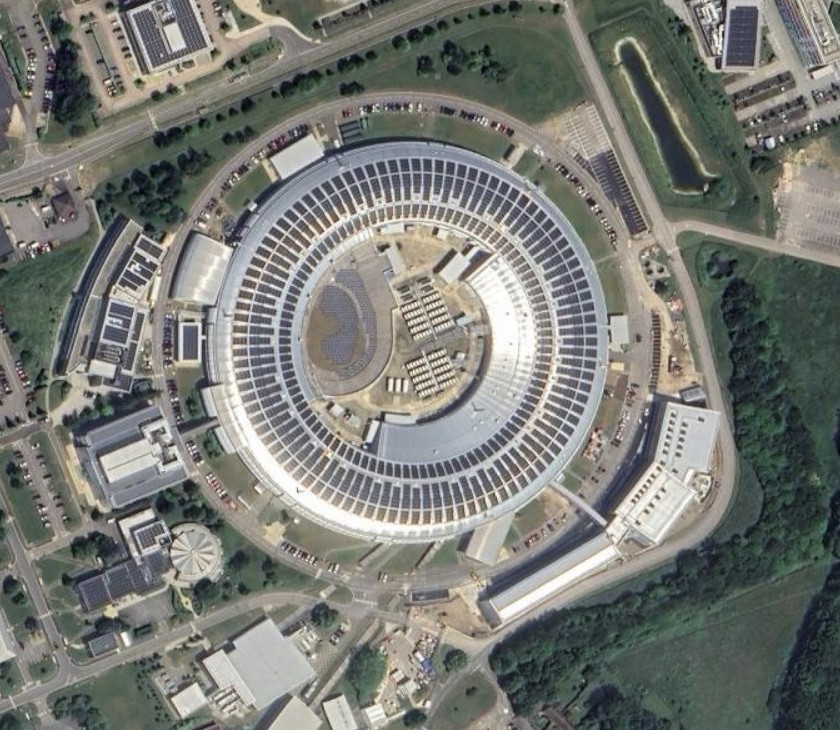
All for now.
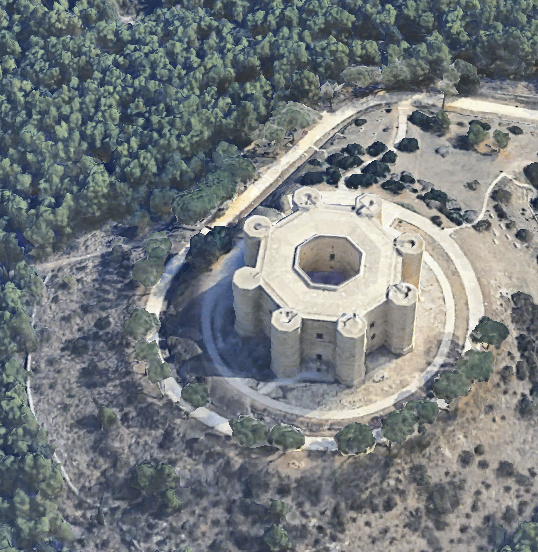
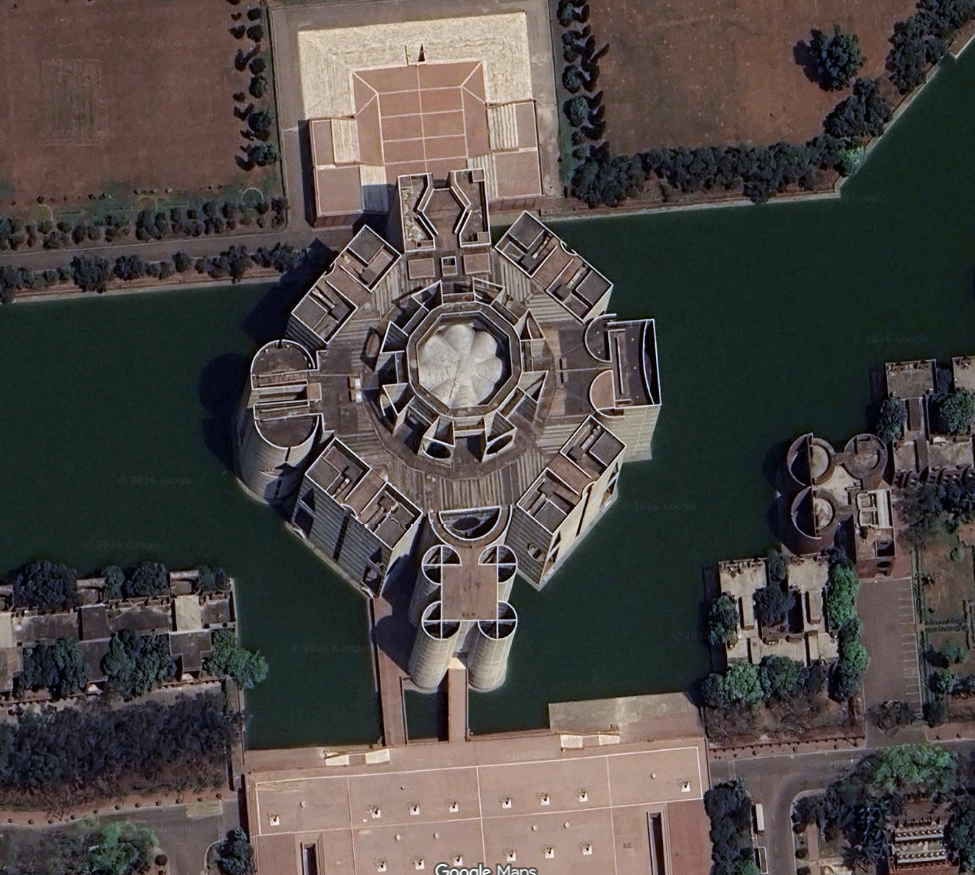
PS: Although not literally derivative, it is striking from an imagery point of view the side by side comparison of the 13th Century Castel Del Monte in Italy to Kahn’s 1960’s Parliament building in Dhaka.
Blog post written by Senior Architect, David Tritt.