Growing up in Southeastern Ohio across the river from Wheeling, West Virginia (Northern Appalachia), my dad was in the mining industry, and as such I was around a lot of big earth-moving machines as a kid - as well as later when I worked highway construction projects for the state and was again around many big machines every day.
The following are some references to the early development and design - the architecture, if you will - of large earth-moving equipment that impressed me as a kid: the draglines and the super power shovels of the 1960s and '70s. (Draglines today are even bigger and badder, it should be noted. These, though, are their precedents.)
It has been disappointing to not be able to find non-copyrighted images of most of the machines I have admired, but I will provide links to photos that try to illustrate my amazement back then.
The Bucyrus-Erie 1250B dragline, first built in the 1940s, fits this category and brings back some of my first memories from visiting the mines with my dad. They no longer exist, but one, named Angeline, can be seen at this link before it was stripped and scrapped.
Angeline is the same model dragline as the two draglines used by the company my dad worked for, Virginia Mining Company -the ones I watched work so intently as a kid. When new, as I remember them, these draglines looked great. Not so much now as they rust away, but I remember especially the red and white color combination; it's a part of my permanent recollection.
Angeline's big brother is a Bucyrus-Erie 1260B named Mike. These were the walking draglines: they had enormous feet that inched along all day. The feet can barely be seen in the Angeline photo, but there are many videos showing how they walk, in particular is old and fascinating one from 1949.
This video demonstrates how draglines work.
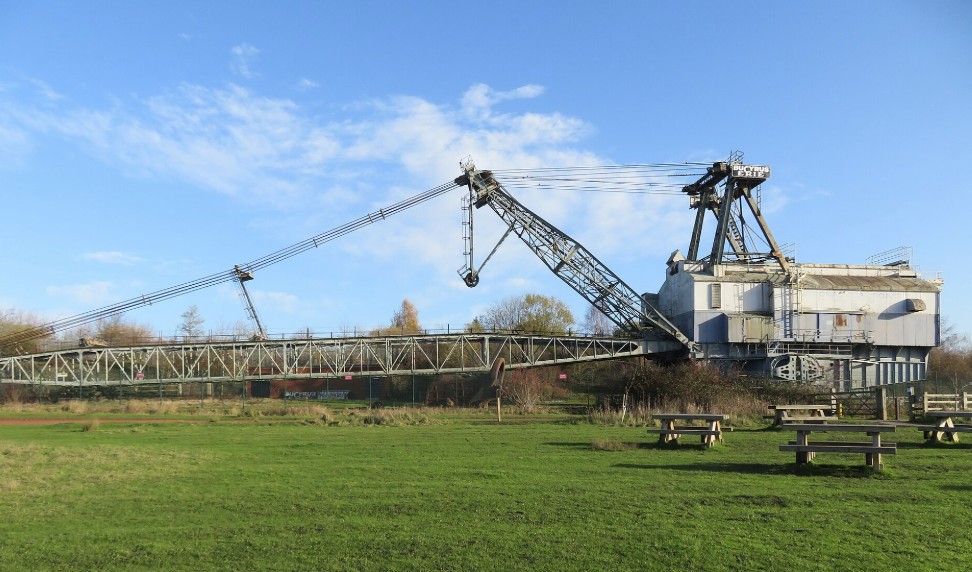
Another Bucyrus-Erie dragline, the 1150B, has been saved as part of St. Aidan's Nature Reserve near Great and Little Preston, England. It resembles almost exactly the later 1250B referenced above (except for the colors - red and white is what I remember). Its name is Oddball:

Another 1150B shows up in a PA mining website video as it rusts away in a field in Pennsylvania. This one was built in 1948 and was considered cutting edge for its time.
This Bucyrus-Erie 1150B is pretty much like one of the draglines I saw as a kid hanging out with my dad. To my mild surprise, it is nameless. In any case, its type was the first walking "super dragline" — a souped-up version of the previous Bucyrus-Erie 950-B, and before that the 400-W walking dragline. See here for is a 1955 ad for the original 480-W.
The power source for all the draglines was a simple 4" cable lying across the ground, connected to the undercarriage. There was a ground person whose job it was to keep this cable lying on the ground and out of the way of other earth-moving equipment and traffic. This cable was linked to a series of electric motors that produced up to 3,175 HP.
By 1961 the next generation of draglines at Bucyrus-Erie, the 1250-W, had been developed. There is a YouTube documentary about one of these later designs called "The Anthracite King," linked below. This version of dragline produced 5,200 HP. The author's personal commentary is interesting. It's a great video:
1250W ANTHRACITE KING video.
As mentioned above, I visited the mines as a kid. Two memories stand out: the first is the enormous size and scale of the draglines mentioned, and the second is the size and scale of a D9 Caterpillar dozer that Dad's friend let me operate when I was about 9 years old. Thrilling. What I remember most, though, is what great guys these strip-mining guys were — funny and full of personality. Before I was born, the story goes that one of them offered to take my pregnant mom out in one of his trucks (she was two weeks late with me) over some of the rough mining roads to get things moving. Mom would tell this story and laugh. My mom was great.
Around this same time in the 1960s came the Super Shovels, as opposed to draglines. The Mountaineer and the Gem of Egypt were the two my dad talked about. There was also the Silver Spade, a matching version of the Mountaineer that came later. The Mountaineer and the Silver Spade both had the larger 65-cubic-yard buckets.
GEM in Gem of Egypt stood for "Giant Earth Mover," and it was located in the Egypt Valley of eastern Ohio. All three have now been scrapped. As a kid, the Gem of Egypt was the coolest name.

The following are two links to the Mountaineer and the Silver Spade: the first is a video of the Mountaineer, and the second is a video of the Silver Spade crossing a road. It demonstrates, I think, the enormous scale of the thing.
A Mountaineer video shows its condition in its last days before being scrapped.
The Silver Spade road crossing video can be found here.
Another Mountaineer video is interesting as well. It documents its own crossing — plus that of the Tiger — over Interstate 70 near Wheeling back in the '70s. It also shows many images of both the Mountaineer and the Gem of Egypt.
Bucket size was always a big deal. Dad would talk about the big mining companies having the much larger 30 CY to 65 CY buckets, and I'd think about how a person could live in one that size. These larger buckets were attached to both draglines and shovels. I believe the Gem of Egypt and the Silver Spade both fall into this bucket size range, with the Silver Spade bucket shown below being the 65-cubic-yard type:

But I never thought the large super shovels mentioned above were as cool as the draglines. They did not walk like the draglines — they crawled on traditional caterpillar tracks — and they were not as big.
That is, until the Captain came along in 1966: a Marion 6360 belonging to P&H Mine Pro. It's enormous.
Finally, the largest earth-moving machine ever built: the Big Muskie dragline, belonging to the Ohio Power Company. It has now been scrapped, but it was — and still is — the largest dragline ever built, standing up to 22 stories tall with a drag bucket of 220 cubic yards. It also had showers and resting quarters for the operators within the cab, which always amazed me:
.jpg)
It’s worth investigating online videos of the design and development of Big Muskie.
Blog post written by Senior Architect, David Tritt.